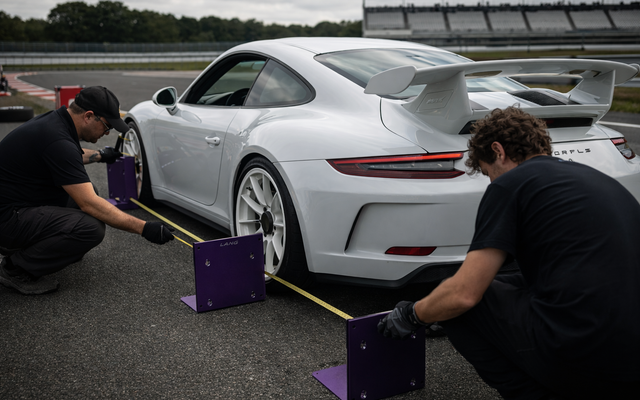
In the demanding arena of today's serious oversteer competition, podium finishes is far more than solely a product of raw engine power or behind-the-wheel aggression. Instead, it has evolved into a intricate science which necessitates a scrupulous marriage of picking a inherently capable chassis, outfitting it with the highest-quality drift-spec components, and, most essentially, comprehending its real-time performance on the circuit through sophisticated drift telemetry software. This definitive manual acts as your roadmap starting from the very first idea of a drift build through to the last telemetry-optimized tweaks that turn a capable machine into a consistent podium finisher. We will delve deep into the art and science of chassis dynamics adjustment, demonstrating how a modern suspension tuning tool like precise measurement hardware eradicates assumptions and provides unmatched visibility into your car's real-world dynamics.
The foundation of any successful competitive sliding vehicle is, undoubtedly, the platform itself. A select group of cars have achieved legendary standing within the international oversteer scene due to their built-in balance, durable build quality, and the enormous range of aftermarket parts available. Selecting the correct platform is the initial and most crucial selection a enthusiast will make. As an example, the BMW E36 is universally acknowledged as among the best overall drift cars of history. Its excellent 50/50 weight distribution, coupled with a rear-wheel-drive layout and robust six-cylinder powerplants, forms a chassis that is simultaneously easy to handle for newcomers and highly effective in the control of a professional competitor. The successor of this concept, the BMW E46, improves on these qualities with a even more refined structure, wider wheel track for greater high-speed stability, and still increased turning capability straight from the manufacturer. Another dominant contender in the pro scene is the Corvette C6.
This American performance car offers a distinctive set of advantages to the sliding discipline, featuring a low-mass alloy structure, a rear-mounted gearbox and differential unit that helps create an perfect weight distribution, and the immense torque of a large-displacement GM LS engine. This fusion transforms it into an complete force on track, designed of entering and sustaining continuous slides with relatively minimal deployment of acceleration. For drivers desiring outstanding bang-for-the-buck, the 350Z model Nissan rises above as a top-tier example. It arrives from the factory with a stiff platform, a competent factory locking differential, and the free-revving V6 engine that offers ample performance for learning and progressing in the discipline. Its follow-up, the 370Z model, brings additional advancements in chassis stiffness, suspension design, and overall engine performance, solidifying its status as a popular selection among serious pilots. Additional historic vehicles that warrant consideration include the nimble Wankel-engined Mazda FC, the ubiquitous Nissan S13, the V8-powered Ford Mustang SN95, the electronic-equipped BMW E90, and the tiny yet incredibly playful and teachable MX-5 Miata. Each of these cars offers a unique array of characteristics, difficulties, and possibilities, but they all have in common the basic elements essential to become a capable sliding vehicle.
However, choosing the optimal car is just the beginning. To release the full performance of every of these vehicles, substantial upgrades to the steering geometry and suspension systems are absolutely mandatory. This is where the world of performance aftermarket components comes into critical view. The one most game-changing upgrade for a dedicated drift car is the fitting of a maximum-angle angle modification kit. These engineered kits, such as those developed by industry leaders like SLR Speed, are engineered to significantly expand the chassis's possible lock-to-lock rotation. A OEM road car is highly restricted in how far its tires can rotate, a engineering trade-off for public road driving. In drifting, however, extreme steering input is frequently needed to manage and sustain a slide. An modification kit exchanges the stock hubs, linkages, and often suspension arms with parts that enable the wheels to achieve angles over 70 or even 80 degrees, as opposed to a typical OEM limit of around 40 to 50 degrees.
This vastly greater steering angle provides the pilot with significantly enhanced control during a slide, enabling it to be far easier to begin a oversteer moment, maintain it through a long turn, and change seamlessly from one direction to the opposite. The contrast in drivability is truly transformative. Coupled with a correctly chosen modification is the equally essential modification to the vehicle's suspension. Store-bought or including premium sport adjustable suspension are simply not designed for the particular and harsh needs of sliding. A drift-spec pair of suspension units is crucial. These engineered coilovers feature unique valving and spring stiffness that are optimized for the rapid load shifting that is characteristic of aggressive driving. When a operator starts a angle, the vehicle's weight is shifted rapidly to the outer of the bend. Proper competition suspension handle this transfer in a predictable way, permitting the chassis to stabilize promptly and giving the driver clear response through the wheel and cockpit. They also provide precise tuning of ground clearance, damping stiffness, and corner weighting, which are all key parts of optimizing the vehicle's handling to a specific track or driving style. Together, a high-quality drift angle kit and a properly chosen pair of performance suspension units are the undeniable physical base upon which all subsequent tuning is built.
Once the essential parts is in place, the subsequent critical phase in the development is the detailed tuning of the car's alignment. This is the realm of car suspension tuning, a process that can feel daunting to the newcomer but is, in fact, the defining factor to converting a assembly of fast parts into a harmonious and controllable machine. The most debated aspect of alignment for oversteer is certainly camber. Wheel camber is the tilt of the wheel relative to the vertical line when looked at from the front-on of the vehicle. If the upper part of the wheel is angled towards the car, this is called inward tilt. For sliding, an inward tilt on the front tires is generally employed and is considered critical. The logic is deeply linked to vehicle dynamics.
When a vehicle is going around a bend at high angles, the frame leans toward the external of the turn. This lean makes the outer steering tire to diminish its optimal footprint with the tarmac. By adding inward lean, the tire is pre-angled to account for this roll. As the chassis leans into the turn, the outside front tire flattens out with the asphalt, increasing its traction at the critical point when it is most required for directional command. Usually, front axle adjustments for a dedicated drift machine fall between approximately -3 degrees to as much as -5 degrees or even more, based on the parameters of the vehicle setup, tire selection, and pilot style. The back tires also employ inward tilt, but the angles are generally more conservative and less aggressive than the front. Too much camber at the back can make the car excessively loose and difficult to predict on throttle use, as it shrinks the usable grip area of the driven wheels during straight-line power delivery. Thus, rear axle adjustments are commonly coilover setup tips in the range of -1 degree drift angle kits to -3 degrees, finding a careful compromise between offering adequate lateral traction to assist in starting and holding the drift while still keeping usable hook-up for acceleration the corner. Camber is just one component of the broader tuning picture, which also encompasses toe setting, caster, and bump steer correction.
Toe angle refers to the angle of the wheels when looked at from a bird's-eye view. Positive toe means the front edges of the tires are closer together than the trailing edges, while negative toe means the converse. For sliding, a small amount of front axle toe out is often run to quicken the initial directional reaction, making the car feel more responsive and willing to initiate a oversteer moment. Rear toe angle is usually set to neutral or a extremely slight amount of inward toe to promote straight-line stability under power. Caster is the frontwards or rearward angle of the kingpin axis when observed from the side-on of the vehicle. Increased positive caster enhances self-centering and high-speed solidity, and it furthermore boosts camber increase during steering, which is very beneficial. Tuning these settings is a complex dance where a change to a single parameter can and will impact the others. The old-school process for dialing in a vehicle's suspension geometry for drifting has long been a labor-intensive process of trial and error. A driver or crew would apply a modification based on experience, run the chassis on track, use the pilot's personal feel and comments, and then make an additional change. This process would repeat time after time until the car felt "right" or the available testing session was exhausted. This methodology is not just incredibly wasteful in terms of time and tires, fuel, and parts, but it is furthermore fundamentally imprecise.
Human feel is a notoriously inconsistent metric, colored by numerous variables such as tiredness, varying track surfaces, ambient heat, and just the mindset of the pilot on that specific session. What feels "oversteery" on one run might feel "pushing" on the following run, leading to contradictory information and ineffective adjustments. This long-standing challenge in chassis setup is exactly where contemporary engineering tools has stepped in to completely change the landscape.
The development and integration of specialized vehicle dynamics tools has brought about a radically different paradigm for building and perfecting competitive sliding vehicles. These systems, showcased by groundbreaking products like GripDial, function by directly recording the live mechanical behavior of the car as it is being driven on the circuit. Unlike depending on subjective feel, these devices gather objective metrics on critical factors such as suspension travel, wheel speed, lateral and longitudinal g-forces, steering angle, and accelerator and brake pedal application. This collected telemetry is then interpreted by advanced software that can plot and decode the data in a clear format. For the first time, drivers and crews can see specifically what the vehicle is exhibiting at every moment of a lap. This capability changes the complete alignment optimization workflow. Imagine the specific task of setting the front negative camber for a given chassis. As an alternative to introducing a adjustment from -3 degrees to -3.5 degrees and then running multiple laps to try and "sense" a improvement, a suspension tuning tool can deliver real-time and definitive feedback. The application can display in a chart how the suspension's contact patch is performing during the critical moments of a slide: the initial flick, mid-corner, and transition. It can demonstrate if the existing angle is enabling the loaded tire to achieve optimal contact or if the tire is over-stressed on its outside edge.
The tool can subsequently provide empirical suggestions for change. Perhaps the telemetry indicates that the tire is still overloading its outer shoulder at -3.5 degrees of camber, suggesting that even more negative camber, say -4 degrees, might be beneficial. Conversely, the data might show that the tire is failing to achieving heat or that the inside edge is degrading unevenly, which could indicate that there is excessive angle and a modest decrease back to -3.2 degrees would be better optimal. This level of precision and actionable insight was completely impossible in the days of solely mechanical tuning.
The effect of using a advanced suspension tuning tool reaches much further than merely setting camber angles. It becomes an invaluable suspension tuning guide that is specific to your particular vehicle. When fine-tuning the rebound and compression clickers on your adjustable dampers, instead of depending on vague guidelines or mimicking another driver's setup, you can employ the software to observe how the car is reacting in response to your tweaks. The tool can graph the damper movement path over a lap, highlighting if the shocks are managing the weight transfer optimally or if they are allowing the car to become unsettled too much after a transition. It can assist in pinpointing problems like excessive compression or topping out, allowing you to introduce educated decisions to spring preload, rebound/compression rates, or stance. This process applies similarly to the detailed art of car alignment tuning. In addition to camber, the software can provide insight into how changes to toe settings and caster angle are affecting the chassis's handling during various maneuvers of a lap. For example, it can help you to ascertain the ideal amount of front axle toe-out for your individual angle kit setup and competition technique by measuring the quickness of initial response and the predictability of the car at maximum lock. This turns the system an extremely powerful performance optimization handbook that is actively updated by the live behavior of your own vehicle on the circuit. It moves the whole endeavor from a mysterious craft into a repeatable development exercise.
Furthermore, the utility of a platform like modern telemetry is not at all confined to experienced tuners with extensive resources. For the amateur driver, it functions as an powerful educational tool. It effectively gives the builder with the knowledge of a expert race engineer without needing the corresponding cost. It drastically shortens the learning curve by providing unambiguous solutions to questions that would traditionally take seasons of experience to understand. A tuner can understand how their individual chassis behaves to specific adjustments, building a deeper knowledge of car control in the process. It furthermore makes accessible high-level suspension engineering principles, allowing anyone with the drive to optimize their car to accomplish it in a systematic and effective way. This is particularly significant in a activity like sliding, where setup expertise has traditionally been a closely guarded asset among top teams. Today, that knowledge can be in the garage of every dedicated builder.
In conclusion, the path to building and dialing in the ideal championship-contending sliding vehicle is a multi-faceted mission that seamlessly blends classic hardware knowledge with cutting-edge data solutions. drift telemetry software It begins with the wise selection of a capable car, then enhanced by the application of essential performance hardware like maximum-angle drift angle kits and correctly selected competition adjustable dampers. The process then advances into the intricate phase of car suspension tuning, where settings like negative camber, toe, and caster angle are meticulously set to complement the car's modified geometry and the driver's individual technique. Ultimately, and what truly distinguishes the modern approach from the traditional methods, is the integration of a sophisticated vehicle dynamics tool. This tool eliminates the guesswork and inefficiency of purely subjective tuning by giving objective, actual information on how the car is truly behaving. It serves as an indispensable suspension tuning tool, a comprehensive coilover setup manual, and a comprehensive vehicle dynamics tool. As a complete package, this holistic approach leads to that every element of the drift machine—from the selection of the car to the most minute adjustment on the damper—is optimized for ultimate competitiveness on the circuit. It represents the total progression of the sport of drifting, connecting mechanical pilot talent with surgical chassis dynamics to build the most dominant cars possible.